Attention: The 2026 kids art contest is coming soon.
For over 200 million years, ponds, marshes, grasslands, and rain forests have come alive with the calls of frogs. Yet these remarkable and colorful animals are declining at such a rapid rate that they are being called the Earth's next dinosaurs. According to the IUCN Red List of Threatened Species, a third of the world's amphibian species are threatened with extinction.
World-renowned Harvard biologist E.O. Wilson has written in the book, The Creation: An Appeal to Save Life on Eart
Kermit the Frog, to summarize the situation in a phrase, is sick. And to varying degrees so is much of the living world. Might Homo sapiens follow? Maybe, maybe not. But with certainty we are the great meteorite of our time, having begun the sixth mass extinction of Phanerozoic history. We are creating a less stable and interesting place for our descendants to inherit.
Frogs are threatened by habitat loss, climate change, pollution, and disease. Because they breathe and drink through their skin, they are extremely sensitive to an unhealthy environment. Chemicals, pesticides, ozone, and UV are dangerous, even deadly, to them.
This New Jersey nonprofit organization is called FROGS ARE GREEN because we believe that healthy frogs mean a healthy planet. By saving the frogs, we will also save our planet—and ourselves.
Please hop in and get involved. We'd love to hear from you!
— Susan Newman Lerer, Founder
"I believed in your cause from the start and who couldn't? Our climate is in turmoil and during these turbulent times, I hope the outcome will be climate action. The Frogs Are Green program is a reminder and an opportunity to learn how the ecosystem works. And how artists can impact society by being visual heralds to educate everyone that the health of our planet is our route to survival. I so appreciate your enthusiasm, dedication, and intuitiveness to see the path to healing through nature. Thank you for including the students of Jersey City Public Schools in the process. I wish you happiness and health in the days ahead and always."
- Ann Marley, Supervisor, Visual Arts, K-12 (Retired 2020)
Artistically Talented Curriculum-Primary, Elementary, Middle School
JC Arts Junior Academy Grade 8-JC ARTS HS Program- Fine Arts
2.5.2016 Frogs Are Green and our environmental/art awareness program was featured in THISLEARNING! by Kris Van Nest." >> Susan uses frogs to teach kids about saving our planet."
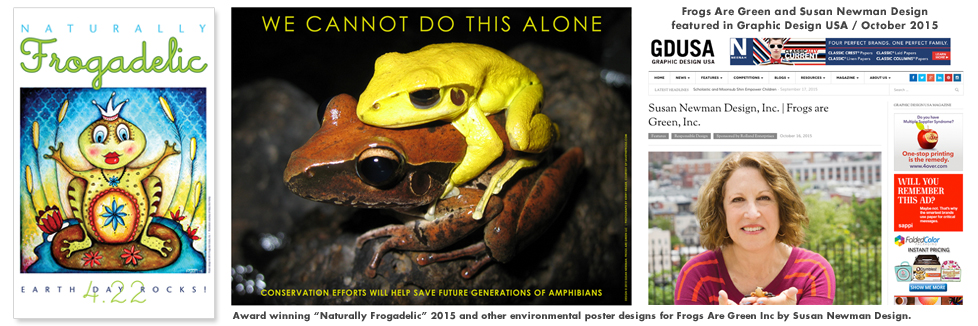
Poster Design Award from Graphic Design USA for "Naturally Frogadelic" Illustration courtesy of Mary Ann Farley • Graphic Design Award for the Frogs Are Green Environmental Poster "We cannot do this alone" for amphibian conservation • Frogs Are Green and Susan Newman Design are featured in the October 2015 Green Issue of Graphic Design USA. Photo of Susan above in GD USA by Alyssa Bredin.
Video from JC1TV!
Thank you Stan Eason for this video of the "Frogs and Their Threatened Environment" exhibition, May 2015 in Jersey City's City Hall Rotunda.
The video below showcases Spring 2014's exhibition at The Distillery Gallery of international frog art by children aged 3-12, from more than 27 countries. The exhibition was well attended and a special thank you to Mayor Steven Fulop of Jersey City and JC1TV for helping broadcast this issue. Now that all the winners have been announced for 2014 contests, we have scheduled exhibitions around Earth Day and Save the Frogs Day 2015.
Frogs Are Green is on an awareness mission to educate the public about the threats to frogs and amphibians. Through blogging, interviews, social media and annual events we have reached a great many people but now it's time to go to the next level and bring a new curriculum to the schools.
Young children are naturally curious about nature and can express themselves through art in a way they cannot verbally, so this curriculum developed by Susan Newman, founder of Frogs Are Green, combines science and art together in a six-week course. (Click below to learn much more about this!)
Amphibian Art Curriculum - K-3
Frogs, Amphibians, and Their Threatened Environment
Discovery and Expression Through Art - K-3
Summary:
Children in K-3 are introduced to frogs, amphibians and the world that surrounds them. By learning about the Earth’s environment and wildlife and having an understanding of the eco-system, they can creatively express themselves through art and share with others how everyone can help the earth by being eco-friendly. Students will be introduced to amphibian
photographers and artists, both classical and current.
Firenze University Press Book Review: Frogs, Amphibians and Their Threatened Environment - Discovery and Expression Through Art - K-3
Excerpt:
...In such a sense the book “built” (not only and not simply written) by Susan Newman is for me a real jewel. In many ways. This book is mainly destined to educators and provides a true roadmap to teach young readers and explorers the love for amphibians. Susan has coped her strong passion for frogs (she is the founder and the promoter of “Frogs Are Green”, a non profit organization created in 2009 to bring awareness to what’s happening on our planet, especially to the fact that frogs everywhere are disappearing: http://frogsaregreen.org/) with art. In such a way the aim of the organisation is to give kids the opportunity to learn about the environment, frogs and other amphibians, and to express themselves through art. In this way Susan’s love for science has been put together with the great and somehow innate interest that children (in this case up to the 3rd grade) have for frogs and drawings...
- Franco Andreone, Museo Regionale di Scienze Naturali, Via G. Giolitti, 36, I-10123 Torino, Italy. E-mail: franco.andreone@regione.piemonte.it
Get it on Amazon!